Computational PDEs
banner

Research Group Computational PDEs

Finite element methods for flow problems and problems on moving and complex geometries — University of Göttingen.

Many physical processes are modelled by partial differential equations (PDEs), yet only rarely can these be solved analytically. We develop and analyse modern numerical methods — primarily finite element methods — that deliver reliable approximations efficiently, stably and in a structure-preserving way.

News & Events

All news →

Sep 7–9, 2026 research upcoming
'100 years since Erich Trefftz's 1926 seminal paper' — Vienna, Austria.
Jun 29 – Jul 1, 2026 software
The annual NGSolve user meeting — Winterthur, Switzerland. We are featuring new NGSolve tutorials (Christoph Lehrenfeld), a talk on "Releasing the pressure for Surface Navier–Stokes" (Tim van Beeck, see the program), and a presentation of ngstrefftz, the package for Trefftz methods in NGSolve (Paul Stocker).
Tim van BeeckChristoph LehrenfeldPaul Stocker
Jun 2026 achievement
Tim van Beeck has been selected for a DAAD research fellowship for doctoral candidates — congratulations, Tim! This fall he will continue his research on nematoacoustics at the University of Oxford, in collaboration with Patrick Farrell and Umberto Zerbinati.
Tim van BeeckPFUZ
Jun 2026 research
New preprints: Trefftz DG for Navier-Stokes (2-part series)
A two-part series on embedded Trefftz DG methods for steady incompressible flow — to our knowledge the first Trefftz analysis for a genuinely nonlinear PDE, with optimal convergence rates. Part I covers the Oseen problem; Part II extends to the full nonlinear Navier-Stokes equations via a Picard fixed-point argument.
Paul StockerIVChristoph LehrenfeldPL
2026 research
High-order surface flow discretizations via discrete Helmholtz–Hodge decompositions, by T. Brüers, C. Lehrenfeld, T. van Beeck, M. Wardetzky.
TBChristoph LehrenfeldTim van BeeckMW
2026 research
Pressure-robustness for the axisymmetric Stokes problem by velocity reconstruction, by P. L. Lederer, C. Lehrenfeld, C. Merdon, T. van Beeck.
PLChristoph LehrenfeldTim van Beeck
always fun
A nerdy card game on inf-sup stable finite element pairs for the Stokes problem.
Dec 2025 research
Streamfunction-vorticity formulation for incompressible viscid and inviscid flows on general surfaces, by T. Brüers, C. Lehrenfeld, M. Wardetzky.
TBChristoph LehrenfeldMW
Oct 2025 supervision
'On the Conforming Trefftz Finite Element Method and Applications'.
Johann Carl Meyer
Apr 2025 research
Hybrid discontinuous Galerkin discretizations for the damped time-harmonic Galbrun's equation, by M. Halla, C. Lehrenfeld, T. van Beeck.
MHChristoph LehrenfeldTim van Beeck
Mar 2025 research
Analysis and numerical analysis of the Helmholtz-Korteweg equation, by P. E. Farrell, T. van Beeck, U. Zerbinati.
Tim van BeeckUZ
Jan 2025 supervision
'Higher Order Unfitted Space-Time Finite Element Methods for Moving Domain Problems'.
Fabian Heimann

Research

All topics →

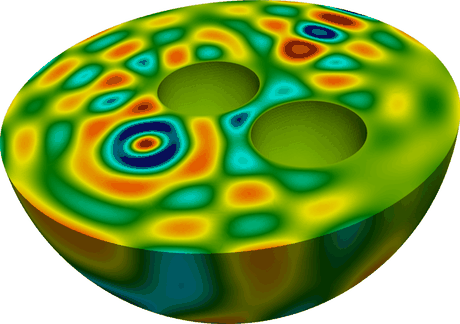
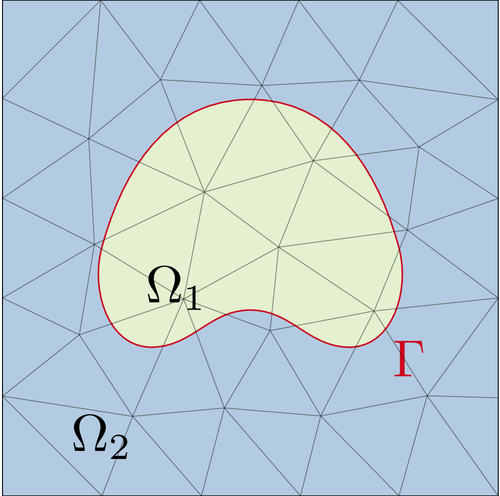
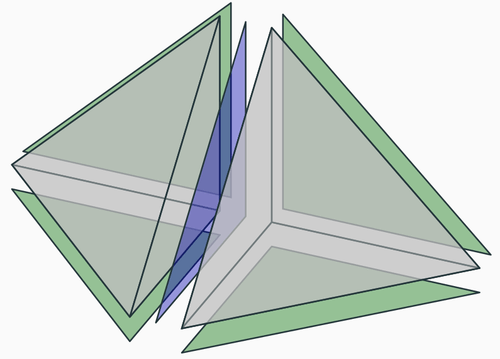
Geometrically unfitted finite element methods

High-order accurate, robust finite element methods for PDEs on complex and moving geometries that are not resolved by the computational mesh.
Unfitted FEM

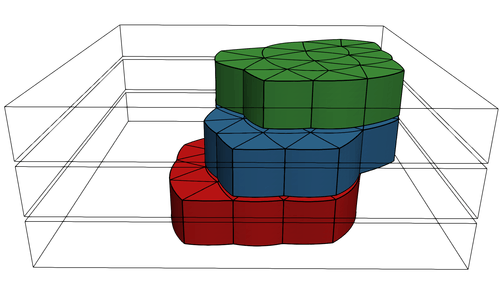
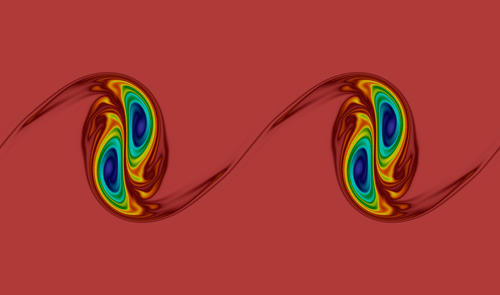
Space-time finite element methods

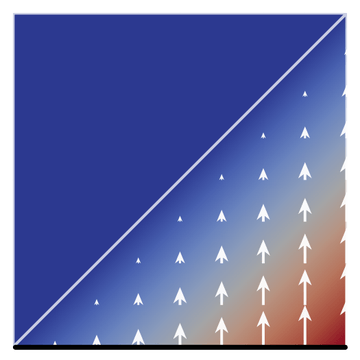
Higher-order space-time discretizations for PDEs on moving domains — provably high-order accurate in space and time.
Space-time FEM Moving domains

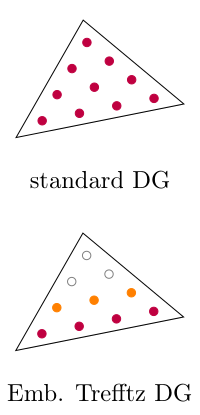
Trefftz and embedded Trefftz DG methods

A flexible, efficient route to Trefftz discontinuous Galerkin methods that drastically reduces the cost of DG while keeping its approximation power.
Trefftz

Structure-preserving discretizations for flows

Pressure-robust, exactly divergence-free H(div)-conforming finite element methods for incompressible flows.
Structure-preserving flows Pressure-robustness HDG

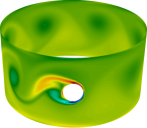
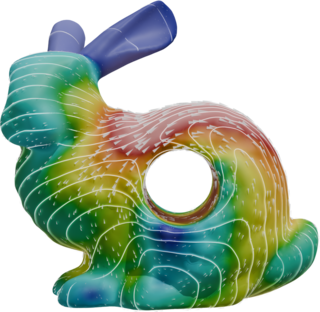
Incompressible flows on curved surfaces

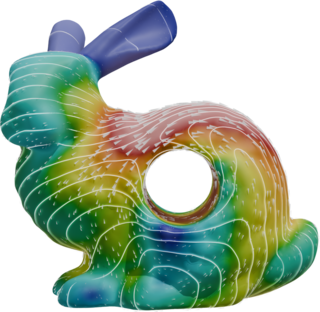
Structure-preserving higher-order discretizations for incompressible viscous and inviscid flows posed on general curved surfaces.
Surface flows Structure-preserving flows Pressure-robustness

Hybrid Discontinuous Galerkin methods

Reducing the cost of discontinuous Galerkin methods through hybridization, enabling efficient high-order and structure-preserving discretizations.
HDG

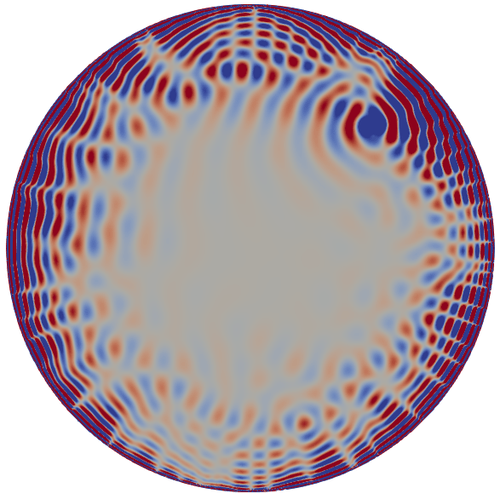
Wave propagation, Galbrun's equation & helioseismology

Stable and efficient discretizations for time-harmonic wave propagation in stratified media, driven by the modelling of oscillations of the Sun.

Galbrun Helmholtz Helioseismology

Further topics

Further threads of the group — analog computing, reduced-order modeling, and open science / reproducible research (LiveDocs).

Reduced-order modeling Analog computing Open Science