Computational PDEs

Publications

Options
Columns
Type
Topic
Has

91 publications

Preprints

2026

Releasing the pressure: High-order surface flow discretizations via discrete Helmholtz–Hodge decompositions

Tim Brüers, Christoph Lehrenfeld, Tim van Beeck, Max Wardetzky

arXiv preprint arXiv:2603.27714 · 2026

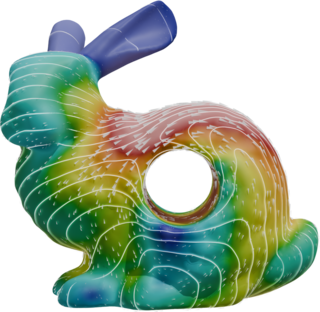
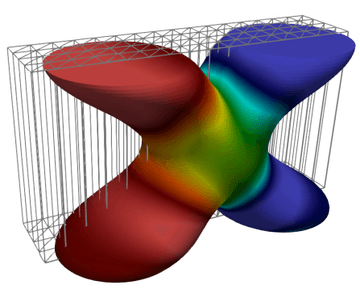
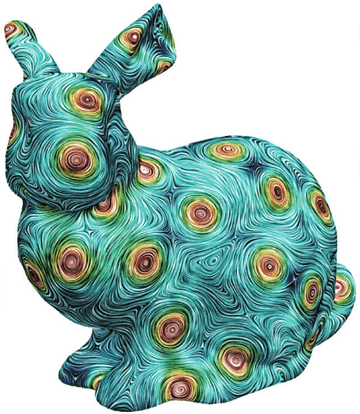
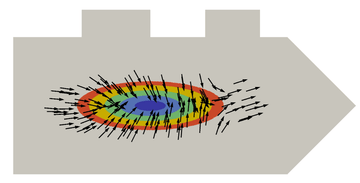
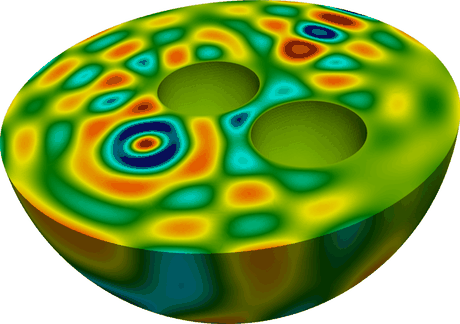
We present a discrete Helmholtz–Hodge decomposition for H(div)-conforming Brezzi–Douglas–Marini (BDM) finite elements on triangulated surfaces of arbitrary topology. The divergence-free BDM subspace is split L2-orthogonally into rotated gradients of a continuous streamfunction space and a finite-dimensional space of discrete harmonic fields whose dimension equals the first Betti number of the surface. Consequently, any incompressible flow discretized on this subspace can be reformulated with a scalar streamfunction and finitely many harmonic coefficients as the only unknowns. This eliminates the pressure and the saddle-point structure while ensuring exact tangentiality, pointwise divergence-freeness, and pressure-robustness. We present a randomized algorithm for constructing the harmonic basis and discuss implementation aspects including hybridization, efficient treatment of the harmonic unknowns, and pressure reconstruction. Numerical experiments for unsteady surface Navier–Stokes equations on a trefoil knot and a multiply-connected sculpture surface demonstrate the method and illustrate the physical role of the harmonic velocity component.

Pressure-robustness for the axisymmetric Stokes problem by velocity reconstruction

Philip L. Lederer, Christoph Lehrenfeld, Christian Merdon, Tim van Beeck

arXiv preprint arXiv:2603.01030 · 2026

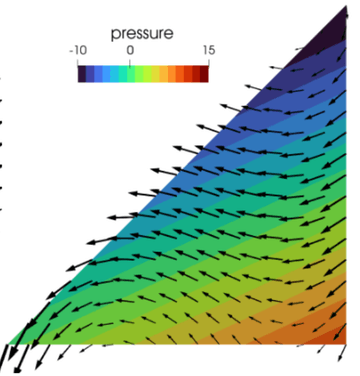
This paper studies pressure-robustness for the axisymmetric Stokes problem. The transformation to cylindrical coordinates requires that the radially weighted velocity is divergence-free in the classical sense. Consequently, traditional divergence-free finite element methods from the Cartesian setting – even if inf-sup stable – are in general not divergence-free in the axisymmetric formulation. We therefore explore the approach that restores pressure-robustness via reconstruction operators for a low-order Bernardi–Raugel discretization. We show that an application of standard interpolation operators from the Cartesian setting to radially weighted test functions works in principle, but it lacks properties needed to derive optimal consistency error estimates. To address this, we introduce a reconstruction operator into a finite element space spanned by Raviart–Thomas functions that are modified such that they vanish on the rotation axis. This vanishing-on-axis property is the key to obtain optimal consistency error estimates. Numerical examples demonstrate the overall feasibility of the approach and include cases where the vanishing-on-axis property yields significantly better results.

Embedded Trefftz DG method for steady Navier-Stokes flow. Part I: Oseen linearization

Paul Stocker, Igor Voulis, Christoph Lehrenfeld, Philip L. Lederer

2026

#Trefftz DG#Structure-preserving flows Oseen

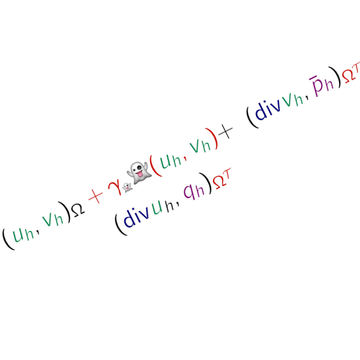
We develop an embedded Trefftz-DG method for the Oseen problem and prove a complete stability and quasi-optimality theory in standard DG norms. The key ingredient is a construction of a suitable local complement space to the Trefftz space, on which the Oseen operator is stably invertible. We also derive a reduced formulation of the method, the resulting system is posed in terms of the velocity unknown only, a crucial step in the analysis especially for the nonlinear Navier-Stokes problem in Part II.

Embedded Trefftz DG method for steady Navier-Stokes flow. Part II: Nonlinear problem

Paul Stocker, Igor Voulis, Christoph Lehrenfeld, Philip L. Lederer

2026

#Trefftz DG#Structure-preserving flows nonlinear

We develop and analyze an embedded Trefftz-DG method for the steady incompressible Navier-Stokes equations, based on the reduced Oseen discretization from Part I. The main difficulty is that the reduced Trefftz space depends on the convection field, so successive Picard iterates live in different discrete spaces. We address this by constructing projections between convection-dependent Trefftz spaces and using them to control the reduced Oseen solution map. Under suitable resolution and small-data assumptions, we prove existence of discrete solutions, uniqueness, and convergence of the Picard iteration. We also derive an a priori error analysis by relating the method to the underlying DG discretization, thereby inheriting convergence properties from compatible DG Navier-Stokes analyses. Numerical experiments on standard incompressible-flow benchmarks illustrate the theory.

2025

Streamfunction-vorticity formulation for incompressible viscid and inviscid flows on general surfaces

Christoph Lehrenfeld Tim Brüers, Max Wardetzky

arXiv preprint arxiv:2512.20763 · 2025

#Structure-preserving flows#Surface flows Streamfunction-vorticity formulationEuler equationHodge decompositionincompressible flows

This paper presents a streamfunction-vorticity formulation for the Navier–Stokes and Euler equations on general surfaces. Notably, this includes non-simply connected surfaces, on which the harmonic components of the velocity field play a fundamental role in the dynamics. By relying only on scalar and finite-dimensional quantities, our formulation ensures that the resulting methods give exactly tangential and incompressible velocity fields, while also being pressure robust. Compared to traditional methods based on velocity-pressure formulations, where one can only guarantee these structural properties by increasing the computational costs, this is a key advantage. We rigorously validate our formulation by proving its equivalence to the well understood velocity-pressure formulation under reasonable regularity assumptions. Furthermore, we demonstrate the applicability of the approach with numerical examples.

Analysis and numerical analysis of the Helmholtz-Korteweg equation

Patrick E. Farrell, Tim van Beeck, Umberto Zerbinati

2025

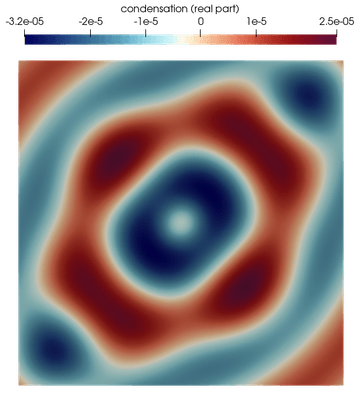
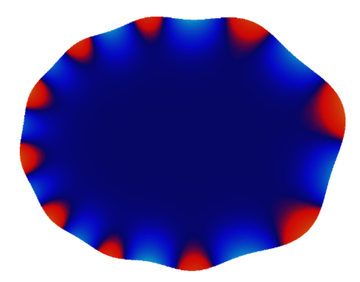
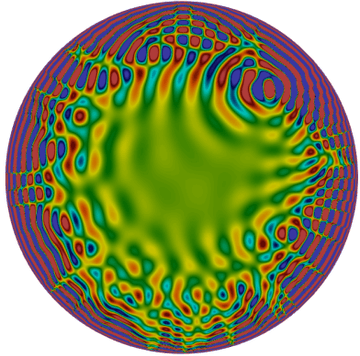
We analyse the nematic Helmholtz-Korteweg equation, a variant of the classical Helmholtz equation that describes time-harmonic wave propagation in calamitic fluids in the presence of nematic order. A prominent example is given by nematic liquid crystals, which can be modeled as nematic Korteweg fluids - that is, fluids whose stress tensor depends on density gradients and on a nematic director describing the orientation of the anisotropic molecules. These materials exhibit anisotropic acoustic properties that can be tuned by external electromagnetic fields, making them attractive for potential applications such as tunable acoustic resonators. We prove the existence and uniqueness of solutions to this equation in two and three dimensions for suitable (nonresonant) wave numbers and propose a convergent discretisation for its numerical solution. The discretisation of this problem is nontrivial as it demands high regularity and involves unfamiliar boundary conditions. We address these challenges by using high-order conforming finite elements and enforcing the boundary conditions with Nitsche's method. We illustrate our analysis with numerical simulations in two dimensions.

Hybrid discontinuous Galerkin discretizations for the damped time-harmonic Galbrun's equation

Martin Halla, Christoph Lehrenfeld, Tim van Beeck

2025

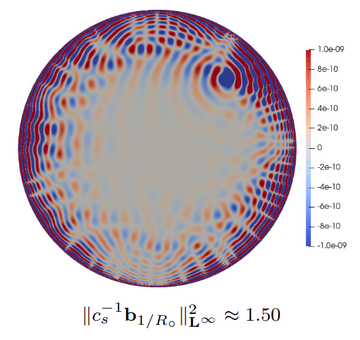
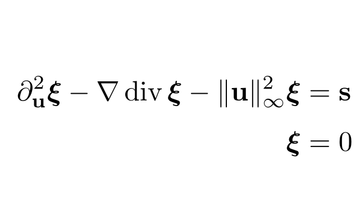
In this article, we study the damped time-harmonic Galbrun's equation which models solar and stellar oscillations. We introduce and analyze hybrid discontinuous Galerkin discretizations (HDG) that are stable and optimally convergent for all polynomial degrees greater than or equal to one. The proposed methods are robust with respect to the drastic changes in the magnitude of the coefficients that naturally occur in stars. Our analysis is based on the concept of discrete approximation schemes and weak T-compatibility, which exploits the weakly T-coercive structure of the equation. Compared to the H^1-conforming discretization of [Halla, Lehrenfeld, Stocker, 2022], our method offers improved stability and robustness. Furthermore, it significantly reduces the computational costs compared to the H()-conforming DG discretization of [Halla, 2023], which has similar stability properties. These advantages make the proposed HDG methods well-suited for astrophysical simulations.

EB

Variational data assimilation for the wave equation in heterogeneous media

Erik Burman, Janosch Preuß, Tim van Beeck

2025

#Wave propagation data assimilationwave equationunique continuation

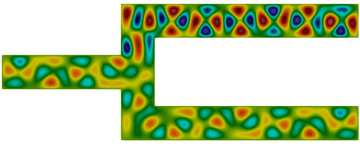
In recent years, several numerical methods for solving the unique continuation problem for the wave equation in a homogeneous medium with given data on the lateral boundary of the space-time cylinder have been proposed. This problem enjoys Lipschitz stability if the geometric control condition is fulfilled, which allows devising optimally convergent numerical methods. In this article, we investigate whether these results carry over to the case in which the medium exhibits a jump discontinuity. Our numerical experiments suggest a positive answer. However, we also observe that the presence of discontinuities in the medium renders the computations far more demanding than in the homogeneous case.

2024

Embedded Trefftz DG framework for the analysis of discretizations with local-global decompositions

Philip L. Lederer, Christoph Lehrenfeld, Paul Stocker, Igor Voulis

arXiv preprint arxiv:2412.00806 · 2024

#Trefftz DG error analysis

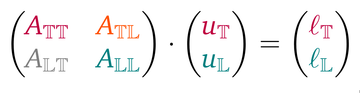
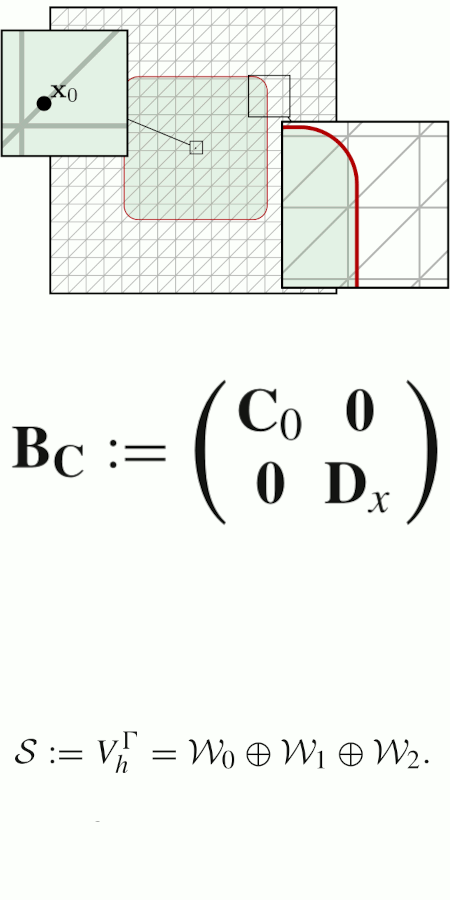
This paper presents a framework for the analysis of discretization methods based on the decomposition into local and global problems. We apply the framework to provide a comprehensive error analysis for the embedded Trefftz discontinuous Galerkin method, for a wide range of second-order scalar elliptic partial differential equations and a scalar reaction-advection problem. We also analyze quasi-Trefftz methods with our framework, presenting the first optimal error bounds in weaker norms.

An adaptive mesh refinement strategy to ensure quasi-optimality of finite element methods for self-adjoint Helmholtz problems

Tim van Beeck, Umberto Zerbinati

2024

It is well known that the quasi-optimality of the Galerkin finite element method for the Helmholtz equation is dependent on the mesh size and the wave-number. In the literature, different criteria have been proposed to ensure uniform quasi-optimality of the discretisation. In the present work, we study the uniform quasi-optimality of H^1 conforming and non-conforming Crouzeix-Raviart discretisation of the self-adjoint Helmholtz problem. In particular, we propose an adaptive scheme, coupled with a residual-based indicator, for generating guaranteed quasi-optimal meshes with minimal degrees of freedom.

LiveDocs: Crafting Interactive Development Environments From Research Findings

Pedro Costa Klein, Christoph Lehrenfeld, Markus Osterhoff, Martin Uecker

arXiv preprint 2402.09475 · 2024

#Misc Open ScienceLiveDocsInteractive Development EnvironmentsResearch SoftwareResearch Findings

Open Science is a recurrent topic in scientific discussion, and there is a current effort to make research more accessible to a broader audience. A focus on delivering research findings that are reproducible, or even re-usable has been proposed as one way of achieving such accessibility goals. In this work, we present the LiveDocs initiative, an effort of the ``Collaborative Research Center 1456 - Mathematics of Experiment'' on tackling common issues of reproducibility and re-usability in scientific publications. The LiveDocs initiative is proposed as a concept alongside a collection of methods that enable scientists to provide research findings under an interactive development environment. This environment allows users from a broader audience to easily reproduce research findings by re-running scripts, for instance, those that generate figures, tables, and other elements from scientific publications. Moreover, LiveDocs also allow the audience to interact with code and data in such environments, thus allowing users to explore algorithms, datasets and software interfaces. This directly lowers the barriers to access and comprehend research methods and findings, which facilitates more scientific exchange and fosters knowledge advancement.

Journal articles

2025

Geometry Error Analysis of a parametric mapping for Higher Order Unfitted Space-Time Methods

Fabian Heimann, Christoph Lehrenfeld

IMA Journal of Numerical Analysis · 2025

#Unfitted FEM#Space-time FEM geometry error analysis

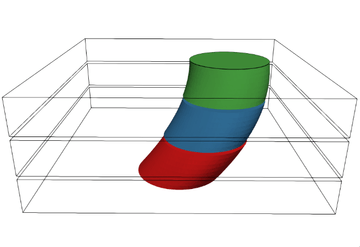
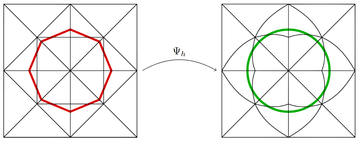
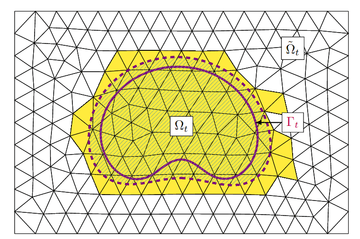
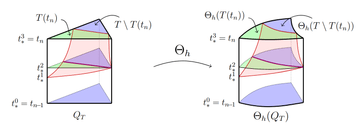
In [Heimann, Lehrenfeld, Preuß, SIAM J. Sci. Comp. 45(2), 2023, B139 - B165] new geometrically unfitted space-time Finite Element methods for partial differential equations posed on moving domains of higher-order accuracy in space and time have been introduced. For geometrically higher-order accuracy a parametric mapping on a background space-time tensor-product mesh has been used. In this paper, we concentrate on the geometrical accuracy of the approximation and derive rigorous bounds for the distance between the realized and an ideal mapping in different norms and derive results for the space-time regularity of the parametric mapping. These results are important and lay the ground for the error analysis of corresponding unfitted space-time finite element methods.

A new T-compatibility condition and its application to the discretization of the damped time-harmonic Galbrun's equation

Martin Halla, Christoph Lehrenfeld, Paul Stocker

IMA Journal on Numerical Analysis · 2025

#Wave propagation discrete approximation schemesweak T-coercivity

We consider the approximation of weakly T-coercive operators. The main property to ensure the convergence thereof is the regularity of the approximation (in the vocabulary of discrete approximation schemes). In a previous work the existence of discrete operators T_n which converge to T in a discrete norm was shown to be sufficient to obtain regularity. Although this framework proved useful for many applications for some instances the former assumption is too strong. Thus in the present article we report a weaker criterion for which the discrete operators T_n only have to converge point-wise, but in addition a weak T-coercivity condition has to be satisfied on the discrete level. We apply the new framework to prove the convergence of certain H^1-conforming finite element discretizations of the damped time-harmonic Galbrun's equation, which is used to model the oscillations of stars. A main ingredient in the latter analysis is the uniformly stable invertibility of the divergence operator on certain spaces, which is related to the topic of divergence free elements for the Stokes equation.

Discretization Error Analysis of a High Order Unfitted Space-Time Method for moving domain problems

Fabian Heimann, Christoph Lehrenfeld, Janosch Preuß

IMA Journal on Numerical Analysis · 2025

#Unfitted FEM#Space-time FEM higher order

We present a numerical analysis of a higher order unfitted space-time Finite Element method applied to a convection-diffusion model problem posed on a moving bulk domain. The method uses isoparametric space-time mappings for the geometry approximation of level set domains and has been presented and investigated computationally in [Heimann, Lehrenfeld, Preuß, SIAM J. Sci. Comp. 45(2), 2023, B139 - B165]. Recently, in [Heimann, Lehrenfeld, IMA J. Numer. Anal., 2025] error bounds for the geometry approximation have been proven. In this paper we prove stability and accuracy including the influence of the geometry approximation.

2024

Trefftz Discontinuous Galerkin discretization for the Stokes problem

Philip L. Lederer, Christoph Lehrenfeld, Paul Stocker

Numerische Mathematik · 2024

We introduce a new discretization based on the Trefftz-DG method for solving the Stokes equations. Discrete solutions of a corresponding method fulfill the Stokes equation pointwise within each element and yield element-wise divergence-free solutions. Compared to standard DG methods, a strong reduction of the degrees of freedom is achieved, especially for higher order polynomial degrees. In addition, in contrast to many other Trefftz-DG methods, our approach allows to easily incorporate inhomogeneous right hand sides (driving forces) by using the concept of the embedded Trefftz-DG method. On top of a detailed a priori error analysis, we further compare our approach to standard discontinuous Galerkin Stokes discretizations and present numerical examples.

Analysis of divergence-preserving unfitted finite element methods for the mixed Poisson problem

Christoph Lehrenfeld, Tim van Beeck, Igor Voulis

Math. Comp. · 2024

#Unfitted FEM mixed FEMdivergence-preserving FEMmixed Poisson problem

In this paper we present a new H(div)-conforming unfitted finite element method for the mixed Poisson problem which is robust in the cut configuration and preserves conservation properties of body-fitted finite element methods. The key is to formulate the divergence-constraint on the active mesh, instead of the physical domain, in order to obtain robustness with respect to cut configurations without the need for a stabilization that pollutes the mass balance. This change in the formulation results in a slight inconsistency, but does not affect the accuracy of the flux variable. By applying post-processings for the scalar variable, in virtue of classical local post-processings in body-fitted methods, we retain optimal convergence rates for both variables and even the superconvergence after post-processing of the scalar variable. We present the method and perform a rigorous a-priori error analysis of the method and discuss several variants and extensions. Numerical experiments confirm the theoretical results.

2023

Geometrically Higher Order Unfitted Space-Time Methods for PDEs on Moving Domains

Fabian Heimann, Christoph Lehrenfeld, Janosch Preuß

SIAM Journal on Scientific Computing · 2023

webpdfdoicode
#Unfitted FEM#Space-time FEM Petrov-GalerkinGalerkin Collocation

We propose new geometrically unfitted space-time finite element methods for PDEs on moving domains of higher order accuracy in space and time. For geometrically higher order accuracy, a parametric mapping is applied on a background space-time tensor-product mesh. For the time discretization, we consider discontinuous Galerkin, continuous Petrov-Galerkin, and Galerkin collocation methods, with ghost-penalty stabilization for robustness with respect to unfavorable cut configurations. Numerical experiments in different dimensions and for different polynomial degrees validate the higher-order accuracy.

Embedded Trefftz Discontinuous Galerkin methods

Christoph Lehrenfeld, Paul Stocker

International Journal for Numerical Methods in Engineering · 2023

webpdfdoicode
#Trefftz DG

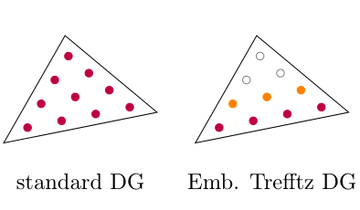
In Trefftz discontinuous Galerkin (TDG) methods, a PDE is discretized using functions that are elementwise in the kernel of the differential operator. We propose the embedded Trefftz DG method, obtained as the Galerkin projection of an underlying DG method onto a Trefftz-type subspace constructed via an embedding operator rather than explicit Trefftz basis functions. The approach extends naturally to inhomogeneous sources and variable coefficient operators. Compared to standard DG, a strong reduction of globally coupled unknowns is achieved in all considered cases. For the Helmholtz problem, accuracy similar to plane-wave TDG methods is observed.

Unfitted Trefftz discontinuous Galerkin methods for elliptic boundary value problems

Fabian Heimann, Christoph Lehrenfeld, Paul Stocker, Henry von Wahl

ESAIM: M2AN · 2023

#Unfitted FEM#Trefftz DG Numerical Analysis (math.NA)

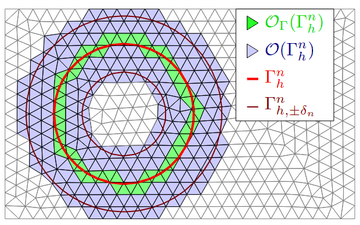
We develop and analyze unfitted Trefftz discontinuous Galerkin (TDG) methods for elliptic boundary value problems on domains described implicitly by level set functions. Combining the unfitted FEM approach – with ghost-penalty stabilization for arbitrary cut configurations – with the Trefftz paradigm of elementwise PDE solutions as basis functions yields a highly sparse discrete system with significantly fewer globally coupled degrees of freedom than standard unfitted DG. We prove stability and optimal order a priori error estimates and validate the results in numerical experiments.

TB

Research-Data Management Planning in the German Mathematical Community

Tobias Boege, René Fritze, Christiane Görgen, Jeroen Hanselman, Dorothea Iglezakis, Lars Kastner, Thomas Koprucki, Tabea Krause, Christoph Lehrenfeld, Silvia Polla, Marco Reidelbach, Christian Riedel, Jens Saak, Björn Schembera, Karsten Tabelow, Marcus Weber

Eur. Math. Soc. Mag. · 2023

webpdfdoi
#Misc History and Overview (math.HO)FOS: MathematicsFOS: Mathematics

We discuss the notion of research data for the field of mathematics and report on the status quo of research-data management and planning in the German mathematical community. Several decentralized approaches are presented and compared to needs and challenges faced in three use cases from different mathematical subdisciplines. We highlight the importance of tailoring research-data management plans to mathematicians' research processes and discuss their usage throughout the data life cycle.

2022

NGSTrefftz: Add-on to NGSolve for Trefftz methods

Paul Stocker

Journal of Open Source Software · 2022

webdoicode
#Trefftz DG numerical softwareopen source softwareNGSolve

NGSTrefftz is an open-source add-on package to the finite element software NGSolve providing Trefftz discontinuous Galerkin methods and related techniques. The package implements plane-wave Trefftz-DG methods for the Helmholtz equation and the embedded Trefftz-DG approach, which extends applicability to general PDEs with variable coefficients and inhomogeneous sources. Python and C++ interfaces are provided and the package is compatible with the NGSolve ecosystem for adaptive mesh refinement and high-order methods.

Isoparametric unfitted BDF – Finite element method for PDEs on evolving domains

Yimin Lou, Christoph Lehrenfeld

SIAM Journal on Numerical Analysis · 2022

webpdfdoicode
#Unfitted FEM#Space-time FEM Eulerian time steppingghost penaltystabilizationBDFprojection errors

We propose a new higher-order discretization method for PDEs on moving domains in the setting of unfitted finite element methods. Standard multi-step time integration schemes cannot be directly applied as degrees of freedom may become active or inactive as the domain moves. We overcome this by extending the discrete solution at every timestep and combine BDF time stepping with the isoparametric unfitted FEM. A complete a priori error analysis and numerical experiments confirm higher-order convergence in space and time.

2021

Locking free and gradient robust H(div)-conforming HDG methods for linear elasticity

Guosheng Fu, Christoph Lehrenfeld, Alexander Linke, Timo Streckenbach

Journal of Scientific Computing · 2021

#Structure-preserving flows#HDG methods linear elasticitynearly incompressiblelocking phenomenonvolumelockinggradient-robustness

Robust discretization methods for (nearly-incompressible) linear elasticity are free of volume-locking and gradient-robust. While volume-locking is a well-known problem that can be dealt with in many different discretization approaches, the concept of gradient-robustness for linear elasticity is new. We discuss both aspects and propose novel Hybrid Discontinuous Galerkin (HDG) methods for linear elasticity. The starting point for these methods is a divergence-conforming discretization. As a consequence of its well-behaved Stokes limit the method is gradient-robust and free of volume-locking. To improve computational efficiency, we additionally consider discretizations with relaxed divergence-conformity and a modification which re-enables gradient-robustness, yielding a robust and quasi-optimal discretization also in the sense of HDG superconvergence.

An unfitted Eulerian finite element method for the time-dependent Stokes problem on moving domains

Henry von Wahl, Thomas Richter, Christoph Lehrenfeld

IMA Journal of Numerical Analysis · 2021

We analyse a Eulerian finite element method combining an Eulerian time-stepping scheme for the time-dependent Stokes equations using the CutFEM approach with inf-sup stable Taylor-Hood elements for spatial discretization. The method extends the scalar convection-diffusion framework of Lehrenfeld and Olshanskii to the non-stationary Stokes problem on moving domains. The analysis includes the geometrical error from integrating over approximated level-set domains. The method is implemented and the theoretical results are illustrated using numerical examples.

ngsxfem: Add-on to NGSolve for geometrically unfitted finite element discretizations

Christoph Lehrenfeld, Fabian Heimann, Janosch Preuß, Henry von Wahl

Journal of Open Source Software · 2021

webdoicode
#Unfitted FEM numerical softwareopen source softwareNGSolve

ngsxfem is an open-source add-on library to the finite element software NGSolve for simulation of PDEs on geometrically unfitted domains. The library provides tools for level-set-based geometry descriptions, higher-order accurate numerical integration on implicitly defined domains and surfaces, ghost-penalty stabilization, and isoparametric mesh transformations for high-order geometry approximation. It supports both stationary and moving domains in the space-time setting and is accessible through a Python interface.

Learned infinite elements

Thorsten Hohage, Christoph Lehrenfeld, Janosch Preuß

SIAM J. Sci. Comput. · 2021

doicode
#Wave propagation transparent boundary conditionsDirichlet-to-Neumann maplearninginfinite elementsrational approximation

We introduce learned infinite elements as a new approach for solving exterior problems on unbounded domains. The method approximates the Dirichlet-to-Neumann operator for the exterior problem by a rational function determined through a learning procedure using solutions of auxiliary problems on finite domains. The resulting transparent boundary conditions are significantly more accurate than classical absorbing boundary conditions. We apply the method to the computational helioseismology problem and demonstrate substantial improvements over classical approaches for modeling solar oscillation modes.

2020

Divergence-free tangential finite element methods for incompressible flows on surfaces

Philip L. Lederer, Christoph Lehrenfeld, Joachim Sch\"oberl

2020

#Structure-preserving flows#Surface flows divergence-conforming finite elementsPiola transformationsurface PDEstangential vector field

In this work we consider the numerical solution of incompressible flows on two-dimensional manifolds. Whereas the compatibility demands of the velocity and the pressure spaces are known from the flat case one further has to deal with the approximation of a velocity field that lies only in the tangential space of the given geometry. Abandoning H^1-conformity allows us to construct finite elements which are – due to an application of the Piola transformation – exactly tangential. To reintroduce continuity (in a weak sense) we make use of (hybrid) discontinuous Galerkin techniques. To further improve this approach, H(_Γ)-conforming finite elements can be used to obtain exactly divergence-free velocity solutions. We present several new finite element discretizations. On a number of numerical examples we examine and compare their qualitative properties and accuracy.

Sweeping preconditioners for stratified media in the presence of reflections

Janosch Preuß, Thorsten Hohage, Christoph Lehrenfeld

Springer Nature Partial Differential Equations and Applications · 2020

#Wave propagation Dirichlet-to-Neumann operatorPreconditioningDomain decompositionHigh-frequency wavesComputational seismologyPerfectly matched layersSweeping preconditioner

In this paper we consider sweeping preconditioners for time harmonic wave propagation in stratified media, especially in the presence of reflections. In the most famous class of sweeping preconditioners Dirichlet-to-Neumann operators for half-space problems are approximated through absorbing boundary conditions. In the presence of reflections absorbing boundary conditions are not accurate resulting in an unsatisfactory performance of these sweeping preconditioners. We explore the potential of using more accurate Dirichlet-to-Neumann operators within the sweep. To this end, we make use of the separability of the equation for the background model. While this improves the accuracy of the Dirichlet-to-Neumann operator, we find both from numerical tests and analytical arguments that it is very sensitive to perturbations in the presence of reflections. This implies that even if accurate approximations to Dirichlet-to-Neumann operators can be devised for a stratified medium, sweeping preconditioners are limited to very small perturbations.

2019

On reference solutions and the sensitivity of the 2D Kelvin–Helmholtz instability problem

Philipp W. Schroeder, Volker John, Philip L. Lederer, Christoph Lehrenfeld, Gert Lube, Joachim Schöberl

Computers & Mathematics with Applications · 2019

video

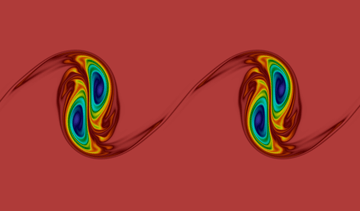
We study the sensitivity of the two-dimensional Kelvin-Helmholtz instability benchmark problem with respect to spatial resolution, time discretization, and the choice of numerical scheme. High-order inf-sup stable divergence-free finite element and DG methods are used to compute reference solutions. Our findings indicate that the long-time behavior is highly sensitive to numerical dissipation and that pressure-robust, energy-stable methods yield qualitatively different results from approaches lacking these properties.

PL

Hybrid Discontinuous Galerkin methods with relaxed H(div)-conformity for incompressible flows. Part II

Philip L. Lederer, Christoph Lehrenfeld, Joachim Schöberl

ESAIM: M2AN · 2019

The present work is the second part of a pair of papers, considering Hybrid Discontinuous Galerkin methods with relaxed H(div)-conformity. The first part mainly dealt with presenting a robust analysis with respect to the mesh size h and the introduction of a reconstruction operator to restore divergence-conformity and pressure robustness using a non conforming right hand side. The aim of this part is the presentation of a high order polynomial robust analysis for the relaxed H()-conforming Hybrid Discontinuous Galerkin discretization of the two dimensional Stokes problem. It is based on the recently proven polynomial robust LBB-condition for BDM elements [P. L. Lederer, J. Schöberl, IMA Journal of Numerical Analysis, 2017] and is derived by a direct approach instead of using a best approximation Céa like result. We further treat the impact of the reconstruction operator on the hp analysis and present a numerical investigation considering polynomial robustness. We conclude the paper presenting an efficient operator splitting time integration scheme for the Navier–Stokes equations which is based on the methods recently presented in [C. Lehrenfeld, J. Schöberl, . Meth. Appl. Mech. Eng., 361 (2016)] and includes the ideas of the reconstruction operator.

An Eulerian Finite Element Method for PDEs in time-dependent domains

Christoph Lehrenfeld, Maxim A. Olshanskii

ESAIM: M2AN · 2019

The paper introduces a new finite element numerical method for the solution of partial differential equations on evolving domains. The approach uses a completely Eulerian description of the domain motion. The physical domain is embedded in a triangulated computational domain and can overlap the time-independent background mesh in an arbitrary way. The numerical method is based on finite difference discretizations of time derivatives and a standard geometrically unfitted finite element method with an additional stabilization term in the spatial domain. The performance and analysis of the method rely on the fundamental extension result in Sobolev spaces for functions defined on bounded domains. This paper includes a complete stability and error analysis, which accounts for discretization errors resulting from finite difference and finite element approximations as well as for geometric errors coming from a possible approximate recovery of the physical domain. Several numerical examples illustrate the theory and demonstrate the practical efficiency of the method.

Numerical benchmarking of fluid-rigid body interactions

Henry von Wahl, Thomas Richter, Christoph Lehrenfeld, Jan Heiland, Piotr Minakowski

Computers & Fluids · 2019

webcode
#Structure-preserving flows BenchmarkingComputational fluid dynamicsFluid–structure interactionFinite elementsCode validationReference values

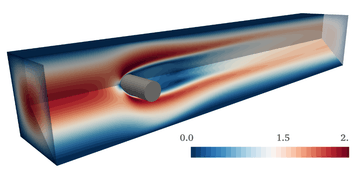
We present a series of numerical benchmarks for the coupled problem of a rigid body freely moving in a viscous incompressible fluid, covering two- and three-dimensional configurations with translational and rotational degrees of freedom. Reference values for drag forces, lift coefficients, and body positions are computed using different numerical methods including unfitted finite element methods and ALE approaches. The benchmark data can serve for validation of fluid-structure interaction codes.

High-order DG solvers for under-resolved turbulent incompressible flows: A comparison of L2 and H(div) methods

Niklas Fehn, Martin Kronbichler, Christoph Lehrenfeld, Gert Lube, Philipp W. Schroeder

International Journal for Numerical Methods in Fluids · 2019

webpdfdoi
#Structure-preserving flows#HDG methods Taylor-Green vortexturbulent channel flowunderresolved turbulent flows

The accurate simulation of turbulent incompressible flows is a challenging problem. Two classes of high-order DG discretizations address mass conservation and energy stability differently: standard L^2-based DG with stabilization terms, and pointwise divergence-free H(div)-conforming DG with tailored function spaces. This comparative study investigates whether these two approaches yield equivalent results for under-resolved turbulent flows. Both strategies prove promising for under-resolved simulations due to their inherent dissipation mechanisms, and their specific differences are highlighted.

2018
CL

Analysis of a high order unfitted finite element method for an elliptic interface problem

Christoph Lehrenfeld, Arnold Reusken

IMA J. Numer. Anal. · 2018

webpdfdoi

Analysis of a High-Order Trace Finite Element Method for PDEs on Level Set Surfaces

Jörg Grande, Christoph Lehrenfeld, Arnold Reusken

SIAM Journal on Numerical Analysis · 2018

webpdf

We present a high order finite element method for PDEs on stationary smooth surfaces implicitly described as the zero level of a level set function. The discretization combines trace finite elements with an isoparametric mapping of the volume mesh. We derive optimal order H^1(Gamma)-norm error bounds and provide a unified analysis of several stabilization methods for trace finite element methods. Only stabilization based on anisotropic diffusion in the volume mesh controls the condition number also for higher order discretizations. Numerical experiments confirm the theoretical findings.

L^2-estimates for a high order unfitted finite element method for elliptic interface problems

Christoph Lehrenfeld, Arnold Reusken

Journal of Numerical Mathematics · 2018

webpdfdoi

In the context of unfitted finite element methods, a new isoparametric method was recently introduced that achieves high order geometry approximation for domains described by level set functions, with optimal H^1-norm error bounds established in a companion paper. In this paper we extend the analysis to derive optimal L^2-norm error bounds for the high order unfitted finite element method applied to elliptic interface problems, providing a complete approximation theory for both energy and L^2 norms.

Towards computable flows and robust estimates for inf-sup stable FEM applied to the time-dependent incompressible Navier-Stokes equations

Philipp W. Schroeder, Alexander Linke, Christoph Lehrenfeld, Gert Lube

SeMA Journal · 2018

webdoi

We investigate how to obtain discretely computable flows with inf-sup stable finite element methods for the incompressible Navier-Stokes equations, focusing on the concept of pressure-robustness: the property that velocity errors are independent of the pressure. We demonstrate that inf-sup stable methods are not automatically pressure-robust and that this property significantly affects flow accuracy. Connections to exactly divergence-free discretizations and energy stability are discussed and illustrated with numerical examples.

A note on the penalty parameter in Nitsche's method for unfitted boundary value problems

Frits de Prenter, Christoph Lehrenfeld, André Massing

Computers and Mathematics with Applications · 2018

webpdfdoi

Nitsche's method is widely applied for weakly enforcing Dirichlet-type conditions in unfitted finite element methods. The stabilization parameter in the classical symmetric formulation must be chosen sufficiently large for unique solvability. In this short note we discuss a commonly used strategy for setting the stabilization parameter and describe a subtle problem that can arise. We show that in specific situations the error bounds deteriorate and provide examples where Nitsche's method yields large and even diverging discretization errors.

Hybrid Discontinuous Galerkin methods with relaxed H(div)-conformity for incompressible flows. Part I

Philip L. Lederer, Christoph Lehrenfeld, Joachim Schöberl

SIAM J. Numer. Anal. · 2018

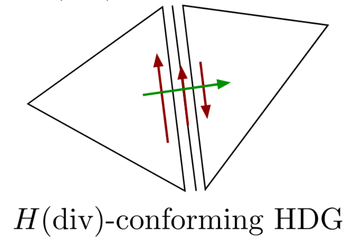
We propose a new discretization method for the Stokes equations. The method is an improved version of the method recently presented in [C. Lehrenfeld, J. Schöberl, Comp. Meth. Appl. Mech. Eng., 361 (2016)] which is based on an H()-conforming finite element space and a Hybrid Discontinuous Galerkin (HDG) formulation of the viscous forces. H()-conformity results in favourable properties such as pointwise divergence free solutions and pressure-robustness. However, for the approximation of the velocity with a polynomial degree k it requires unknowns of degree k on every facet of the mesh. In view of the superconvergence property of other HDG methods, where only unknowns of polynomial degree k-1 on the facets are required to obtain an accurate polynomial approximation of order k (possibly after a local post-processing) this is sub-optimal. The key idea in this paper is to slightly relax the H()-conformity so that only unknowns of polynomial degree k-1 are involved for normal-continuity. This allows for optimality of the method also in the sense of superconvergent HDG methods. In order not to loose the benefits of H()-conformity we introduce a cheap reconstruction operator which restores pressure-robustness and pointwise divergence free solutions and suits well to the finite element space with relaxed H()-conformity. We present this new method, carry out a thorough h-version error analysis and demonstrate the performance of the method on numerical examples.

A stabilized trace finite element method for partial differential equations on evolving surfaces

Christoph Lehrenfeld, Maxim A. Olshanskii, Xianmin Xu

SIAM J. Numer. Anal. · 2018

In this paper, we study a numerical method for the solution of partial differential equations on evolving surfaces. The numerical method is built on the stabilized trace finite element method (TraceFEM) for the spatial discretization and finite differences for the time discretization. The TraceFEM uses a stationary background mesh, which can be chosen independent of time and the position of the surface. The stabilization ensures well-conditioning of the algebraic systems and defines a regular extension of the solution from the surface to its volumetric neighborhood. Having such an extension is essential for the numerical method to be well-defined. The paper proves numerical stability and optimal order error estimates for the case of simplicial background meshes and finite element spaces of order m1. For the algebraic condition numbers of the resulting systems we prove estimates, which are independent of the position of the interface. The method allows that the surface and its evolution are given implicitly with the help of an indicator function. Results of numerical experiments for a set of 2D evolving surfaces are provided.

Mass conservative reduced order modeling of a free boundary osmotic cell swelling problem

Christoph Lehrenfeld, Stephan Rave

Advances in Computational Mathematics · 2018

webpdfcode

We consider model order reduction for a free boundary problem of an osmotic cell parameterized by material parameters and initial cell shape. Our approach is based on an Arbitrary-Lagrangian-Eulerian description discretized by a mass-conservative finite element scheme. Using reduced basis techniques and empirical interpolation, we construct a parameterized reduced order model in which the mass conservation property of the full-order model is exactly preserved. Numerical experiments highlight the performance of the resulting reduced order model.

2017

Optimal preconditioners for Nitsche-XFEM discretizations of interface problems

Christoph Lehrenfeld, Arnold Reusken

Numerische Mathematik · 2017

We consider Nitsche-XFEM discretizations of elliptic interface problems where the interface cuts through the background mesh in an arbitrary fashion. The resulting linear systems are ill-conditioned for unfavorable interface positions. We construct and analyze preconditioners that yield condition numbers independent of the interface position and the mesh size. The preconditioners are based on a transformation of the XFEM degrees of freedom and can be implemented efficiently. Numerical experiments validate the theoretical estimates.

2016

Numerical and experimental analysis of local flow phenomena in laminar Taylor flow in a square mini-channel

Carlos J. Falconi D., Christoph Lehrenfeld, Holger Marschall, Christoph Meyer, R. Abiev, Dieter Bothe, Arnold Reusken, Michael Schl\"uter, Martin W\"orner

Physics of Fluids · 2016

webdoi

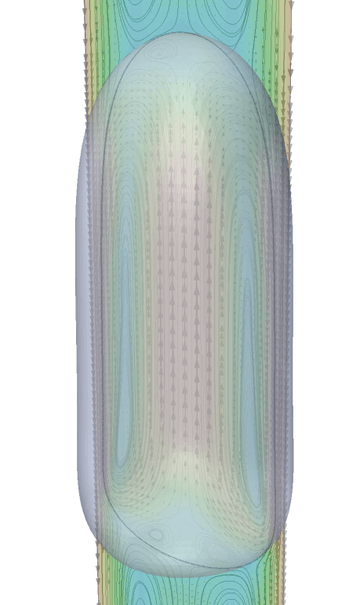
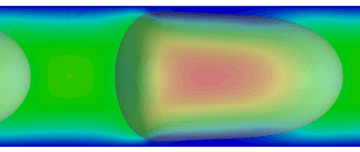
We present a combined numerical and experimental investigation of the local flow field in laminar Taylor flow in a square cross-section mini-channel. High-resolution numerical simulations based on an interface-tracking finite element method are compared against experimental measurements by X-ray particle tracking velocimetry. The study provides detailed insight into the three-dimensional velocity profiles, including secondary flows in the corners of the square channel, finding excellent agreement between simulation and experiment.

High order unfitted finite element methods on level set domains using isoparametric mappings

Christoph Lehrenfeld

Computer Methods in Applied Mechanics and Engineering · 2016

webpdfdoi

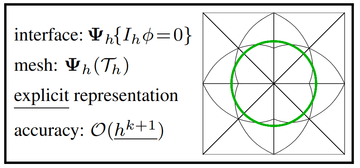
We introduce a new class of unfitted finite element methods with high order accurate numerical integration over curved surfaces and volumes implicitly defined by level set functions. An unfitted FEM suitable for piecewise planar interfaces is combined with a parametric mapping of the underlying mesh, resulting in an isoparametric unfitted finite element method. The parametric mapping significantly improves the interface reconstruction quality, allowing high order accurate computations of unfitted domain and surface integrals. We present the method, discuss implementation aspects, and demonstrate its potential in numerical examples.

High order exactly divergence-free Hybrid Discontinuous Galerkin Methods for unsteady incompressible flows

Christoph Lehrenfeld, Joachim Sch\"oberl

Computer Methods in Applied Mechanics and Engineering · 2016

webpdfdoi

We present an efficient discretization method for the unsteady incompressible Navier-Stokes equations based on a high order Hybrid Discontinuous Galerkin (HDG) formulation. The key idea is to distinguish stiff linear parts from less stiff nonlinear parts in the time integration. Using operator-splitting, we combine an upwind DG method with explicit treatment for the transport part and an H(div)-conforming HDG method with implicit treatment for the Stokes part. The H(div)-conformity guarantees exactly divergence-free velocity solutions; a projection operator reduces globally coupled unknowns. Performance is demonstrated on standard benchmark problems.

2015

The Nitsche XFEM-DG space-time method and its implementation in three space dimensions

Christoph Lehrenfeld

SIAM J. Sci. Comp. · 2015

webpdfdoi

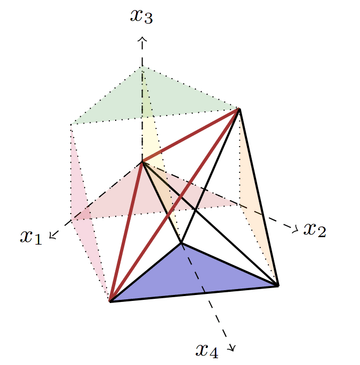
A space-time Nitsche-XFEM-DG method for two-phase mass transport was presented and analyzed in an earlier paper; the main contribution of this work is the discussion of implementation aspects for the spatially three-dimensional case. As the space-time interface is given implicitly as the zero level of a level-set function, a piecewise planar approximation is constructed. An important component is a new method for subdividing four-dimensional prisms intersected by a piecewise planar space-time interface into simplices, which is necessary for numerical integration on the subdomains and on the space-time interface. Numerical studies are presented.

2014
HM

Validation of Interface Capturing and Tracking techniques with different surface tension treatments against a Taylor bubble benchmark problem

Holger Marschall, Stephan Boden, Christoph Lehrenfeld, Carlos J. Falconi D., Uwe Hampel, Arnold Reusken, Martin W\"orner, Dieter Bothe

Computers & Fluids · 2014

webdoi

We present a systematic validation study of interface capturing and tracking methods for multiphase flow with different treatments of surface tension forces. Several approaches – including volume-of-fluid, level-set, and front-tracking methods with various surface tension formulations – are benchmarked against experimental data for a Taylor bubble rising in a vertical channel. The study provides quantitative comparisons of accuracy and robustness of the different approaches for this challenging benchmark problem.

2013

Analysis of a Nitsche XFEM-DG Discretization for a class of Two-Phase Mass Transport Problems

Christoph Lehrenfeld, Arnold Reusken

SIAM J. Numer. Anal. · 2013

webpdfdoi

We study a coupled mass transport problem in two-phase incompressible flow involving a jump discontinuity (Henry condition) at the evolving interface. A stabilized space-time Nitsche-XFEM-DG method is proposed and rigorously analyzed. The analysis yields inf-sup stability and optimal order error estimates in suitable norms. Numerical experiments confirm the theoretical predictions.

2012

Nitsche-XFEM with streamline diffusion stabilization for a two-phase mass transport problem

Christoph Lehrenfeld, Arnold Reusken

SIAM J. Sci. Comp. · 2012

webpdfdoi

We consider a mass transport problem in the setting of two-phase incompressible flow with an evolving sharp interface. The transport of a dissolved species across this interface is characterized by a jump condition (Henry condition) due to different solubility in the two phases. We discretize this problem using a space-time XFEM combined with Nitsche's method to enforce the jump condition weakly, and streamline diffusion stabilization for convection-dominated regimes. A stability analysis and a priori error estimates are derived and the performance of the method is demonstrated in numerical examples.

A Strongly Conservative Hybrid DG/Mixed FEM for the Coupling of Stokes and Darcy Flow

Guosheng Fu, Christoph Lehrenfeld

Journal of Scientific Computing

webdoi

We propose a strongly conservative discretization for the coupled Stokes-Darcy flow problem. The method combines a Hybrid Discontinuous Galerkin (HDG) approach for the Stokes region with a mixed finite element method for the Darcy region, coupled via appropriate interface conditions. The method achieves pointwise mass conservation in both subdomains without additional stabilization for the coupling. An a priori error analysis is provided and numerical examples confirm the theoretical results.

Book chapters

2017

High Order Unfitted Finite Element Methods for Interface Problems and PDEs on Surfaces

Christoph Lehrenfeld, Arnold Reusken

Transport Processes at Fluidic Interfaces · 2017

pdf

We give an overview of high-order unfitted finite element methods for interface problems and PDEs on surfaces. The key ingredient is an isoparametric mapping of the background mesh that achieves high-order accurate geometry approximations for interfaces and surfaces described by level set functions. We discuss the construction of this mapping, its theoretical properties including optimal error estimates, and its application to both bulk interface problems and trace finite element methods for surface PDEs.

HM

Direct Numerical Simulations of Taylor Bubbles in a Square Mini-Channel: Detailed Shape and Flow Analysis with Experimental Validation

Holger Marschall, Carlos Falconi, Christoph Lehrenfeld, Rufat Abiev, Martin W\"orner, Arnold Reusken, Dieter Bothe

Transport Processes at Fluidic Interfaces · 2017

We present detailed direct numerical simulations of single Taylor bubbles rising in a square cross-section mini-channel using an OpenFOAM-based volume-of-fluid solver. The bubble shape and the flow field in the surrounding liquid are analyzed in detail and validated against experimental measurements obtained by X-ray tomography and particle tracking velocimetry. The study provides benchmark-quality reference data for the bubble shape, rise velocity, and the three-dimensional velocity distribution in the liquid slug.

CL

A Higher Order Isoparametric Fictitious Domain Method for Level Set Domains

Christoph Lehrenfeld

Geometrically Unfitted Finite Element Methods and Applications · 2017

doi

We describe the isoparametric fictitious domain method for the numerical solution of PDEs on domains implicitly defined by level set functions. The method applies a parametric mapping to a background mesh that improves the piecewise planar interface approximation to a high-order accurate curved interface representation. We present the methodology, discuss implementation in the NGSolve finite element software, and demonstrate the high-order accuracy in numerical examples for interface problems, surface PDEs, and Stokes interface problems.

2015

Finite Element Techniques for the Numerical Simulation of Two-Phase Flows with Mass Transport

Christoph Lehrenfeld, Arnold Reusken

Computational Methods for Complex Liquid-Fluid Interfaces · 2015

pdf

We review finite element techniques for the numerical simulation of mass transport in two-phase flow, focusing on problems where a dissolved species undergoes a concentration jump at the fluid interface (Henry condition). Both fitted and unfitted (XFEM-based) approaches are discussed, with particular attention to the Nitsche-XFEM-DG space-time method. Theoretical aspects of stability and error analysis, implementation details, and numerical examples are presented.

2013

Domain Decomposition Preconditioning for High Order Hybrid Discontinuous Galerkin Methods on Tetrahedral Meshes

Joachim Schöberl, Christoph Lehrenfeld

Advanced Finite Element Methods and Applications · 2013

webpdfdoi

We present a domain decomposition preconditioning approach for high-order Hybrid Discontinuous Galerkin (HDG) methods discretized on tetrahedral meshes. The preconditioner is based on a subspace decomposition that exploits the facet-based structure of HDG unknowns and combines local block solvers with a coarse space correction. The preconditioner is shown to be robust with respect to the polynomial degree and the mesh size, and its efficiency is demonstrated on model problems.

2012
CK

Computer Algebra Meets Finite Elements: An Efficient Implementation for Maxwells Equations

Christoph Koutschan, Christoph Lehrenfeld, Joachim Schöberl

Numerical and Symbolic Scientific Computing · 2012

pdfdoi

We consider the numerical discretization of the time-domain Maxwell equations with an energy-conserving discontinuous Galerkin finite element formulation. Special emphasis is placed on an efficient implementation achieved by taking advantage of recurrence properties and the tensor-product structure of the chosen shape functions. These recurrences have been derived symbolically with computer algebra methods reminiscent of the holonomic systems approach, demonstrating the synergy between computer algebra and finite element implementations.

Proceedings

2025

A Higher Order Unfitted Space-Time Finite Element Method for Coupled Surface-Bulk problems

Fabian Heimann

Numerical Mathematics and Advanced Applications ENUMATH 2023, Volume 1, Lecture Notes in Computational Science and Engineering · 2025

webpdfdoi

We present a higher order unfitted space-time finite element method for coupled surface-bulk problems in which a partial differential equation is posed simultaneously on a moving bulk domain and on its evolving boundary surface. The method extends the isoparametric unfitted space-time FEM framework to handle the coupling between bulk and surface equations. Numerical experiments on a moving domain demonstrate the expected higher-order convergence in space and time.

2024

Sparsity comparison of polytopal finite element methods

Christoph Lehrenfeld, Paul Stocker, Maximilian Zienecker

PAMM · 2024

#Trefftz DG Numerical Analysis (math.NA)polytopal finite elementssparsity

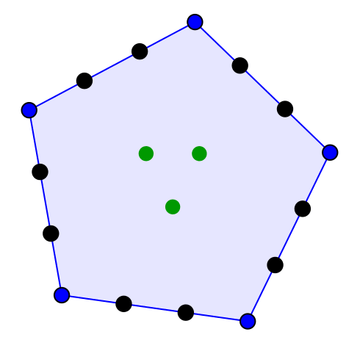
We compare efficiency-relevant parameters of different finite element methods for PDEs on polytopal meshes: the Virtual Element Method (VEM), Hybrid Discontinuous Galerkin (HDG) methods, and Trefftz DG methods. While the VEM generalizes conforming FEM to arbitrary polygonal meshes, HDG and Trefftz DG reduce computational costs through hybridization and Trefftz basis functions, respectively. The association of computational costs to elements versus facets leads to differences in performance across grid types. This paper compares the sparsity of these approaches on different grid configurations.

2022
TA

Robust finite element discretizations for a simplified Galbrun's equation

Tilman Alemán, Martin Halla, Christoph Lehrenfeld, Paul Stocker

ECCOMAS 2022 · 2022

#Wave propagation FEMHelmholtz decomposition

Driven by the challenging task of finding robust discretization methods for Galbrun's equation, we investigate conditions for stability and different aspects of robustness for different finite element schemes on a simplified version of the equations. The considered PDE is a second order indefinite vector-PDE which remains if only the highest order terms of Galbrun's equation are taken into account. A key property for stability is a Helmholtz-type decomposition which results in a strong connection between stable discretizations for Galbrun's equation and Stokes and nearly incompressible linear elasticity problems.

2019

Numerical Integration on Hyperrectangles in Isoparametric Unfitted Finite Elements

Fabian Heimann, Christoph Lehrenfeld

European Conference on Numerical Mathematics and Advanced Applications · 2019

We consider the computation of accurate quadrature rules on hyperrectangles cut by implicit interfaces, which arises in isoparametric unfitted finite element methods on hexahedral and quadrilateral meshes. We propose a recursive subdivision approach combined with the implicit function theorem to integrate accurately over the cut domains. The method is applicable to high-order polynomials and achieves the expected convergence order in numerical experiments.

A natural decomposition of viscous dissipation in DG methods for turbulent incompressible flows

Christoph Lehrenfeld, Gert Lube, Philipp W. Schroeder

PAMM · 2019

webpdfdoi

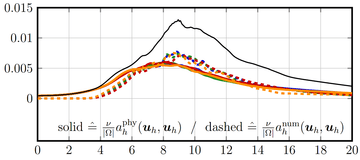
We provide a characterization of the discretization of viscous dissipation in DG-discretized incompressible flow simulations that allows one to distinguish physical (molecular, resolved) from numerical dissipation. This natural decomposition is applied to analyze different high-order DG methods for turbulent incompressible flows, providing insight into the sources of numerical dissipation and their relation to the structure of the discretization.

2017
CL

Higher order unfitted finite element methods for interface problems

Christoph Lehrenfeld

Oberwolfach report · 2017

web

We present an overview of recent advances in higher order unfitted finite element methods for interface problems and PDEs on surfaces. The key challenge is the accurate approximation of the geometry when the computational mesh does not conform to the domain boundary or interface. We discuss the isoparametric approach based on parametric mappings of the background mesh, which achieves optimal higher-order accuracy and is applicable to both bulk interface problems and surface PDEs.

2016

Removing the stabilization parameter in fitted and unfitted symmetric Nitsche formulations

Christoph Lehrenfeld

Proc. of ECCOMAS 2016 · 2016

web

We discuss symmetric Nitsche methods for weakly enforcing boundary and interface conditions in fitted and unfitted finite element methods. The classical formulation requires a stabilization parameter that must be chosen sufficiently large for coercivity. We present a stabilization-parameter-free formulation based on a local projection approach, which avoids tuning while retaining the symmetry and consistency of the method. The approach applies both to fitted and unfitted settings.

Higher order unfitted FEM for Stokes interface problems

Philip L. Lederer, Carl-Martin Pfeiler, Christoph Wintersteiger, Christoph Lehrenfeld

PAMM · 2016

webdoi

We extend isoparametric unfitted finite element methods to Stokes interface problems. The approach combines the parametric mapping technique for accurate high-order geometry approximation with inf-sup stable finite element pairs for the Stokes equations. Numerical examples demonstrate the higher-order convergence of the method for Stokes problems with sharp velocity and pressure jumps at the interface.

2013

Accuracy of two-phase flow simulations: The Taylor Flow benchmark

Sebastian Aland, Christoph Lehrenfeld, Holger Marschall, Christoph Meyer, Stephan Weller

Proc. Appl. Math. Mech. · 2013

webdoi

We present a benchmark study for numerical simulation methods for two-phase flow, focusing on the Taylor flow configuration (a train of gas bubbles separated by liquid slugs in a vertical channel). Several state-of-the-art interface capturing and tracking methods are compared with respect to accuracy and efficiency, and reference values for bubble velocity, bubble shape, and pressure drop are provided.

2011
CL

Nitsche-XFEM for a transport problem in two-phase incompressible flows

Christoph Lehrenfeld

PAMM · 2011

webdoi

We present preliminary results for a finite element discretization of a two-phase mass transport problem with a concentration jump at the fluid-fluid interface (Henry condition). The method is based on the extended finite element method (XFEM) combined with Nitsche's method to weakly enforce the jump condition across the interface. The approach is formulated in a space-time setting that handles the evolving interface without remeshing.

Ph.D. theses

2025

Higher Order Unfitted Space-Time Finite Element Methods for Moving Domain Problems

Fabian Heimann

University of Göttingen · 2025

web

This thesis develops and analyzes higher-order unfitted space-time finite element methods for PDEs on moving domains. The main contribution is a rigorous numerical analysis of isoparametric unfitted space-time methods, including sharp error bounds for the geometric approximation of the moving domain and the resulting influence on the overall discretization error. The analysis builds on earlier computational and geometric results and provides the complete theoretical foundation for the high-order accuracy observed in practice. Numerical experiments confirm the theoretical results for model convection-diffusion and Stokes problems on moving domains.

2023

High-order Unfitted Discretizations for Partial Differential Equations Coupled with Geometric Flow

Yimin Lou

University of Göttingen · 2023

web

This thesis develops high-order unfitted finite element discretizations for partial differential equations coupled with geometric flow, motivated by problems in which the computational domain evolves according to a PDE. The key challenge is achieving high-order accuracy in both the spatial discretization and the geometric approximation of the moving domain. Building on isoparametric unfitted FEM and BDF time discretization, provably higher-order methods are developed and analyzed for convection-diffusion problems on moving domains. The thesis presents a complete a priori error analysis and validates the methods in numerical experiments demonstrating the expected convergence rates.

2021

Learned infinite elements for helioseismology

Janosch Preuß

University of Göttingen · 2021

web

This thesis develops learned infinite elements as a new approach to constructing transparent boundary conditions for helioseismology, specifically for computing the oscillation modes of the Sun. The Dirichlet-to-Neumann operator for the exterior solar problem is approximated by a rational function determined from auxiliary computations on finite domains using a data-driven approach. The method achieves much higher accuracy than classical absorbing boundary conditions and is applicable to the stratified and dispersive solar medium. The thesis provides a mathematical analysis of the method and demonstrates its performance on computational helioseismology benchmarks, including studies of the sensitivity of the solar oscillation spectrum to interior perturbations.

2015

On a Space-Time Extended Finite Element Method for the Solution of a Class of Two-Phase Mass Transport Problems

Christoph Lehrenfeld

RWTH Aachen · 2015

webpdf

This thesis develops and analyzes space-time extended finite element methods (XFEM) for a class of two-phase mass transport problems. The governing equations describe the transport of a dissolved species between two immiscible fluids separated by an evolving sharp interface, with a Henry-type jump condition across the interface. A space-time Nitsche-XFEM-DG discretization is proposed that handles the interface condition weakly and applies to arbitrary interface motion. The thesis provides a complete numerical analysis including stability and optimal order error estimates, as well as implementation details for the fully three-dimensional case and numerical experiments validating the theory.

Master's theses

2025

On the Conforming Trefftz Finite Element Method and Applications

Johann Carl Meyer

NAM, University of Göttingen · 2025

webdoicode

This thesis investigates conforming Trefftz finite element methods, in which the discrete solution space is contained in the kernel of the relevant differential operator. In contrast to standard DG-based Trefftz methods, the conforming variant imposes interelement continuity directly without requiring numerical fluxes. The thesis develops a theoretical framework for constructing conforming Trefftz spaces, analyzes stability and convergence properties, and demonstrates the approach on model problems including the Laplace and Helmholtz equations.

2024
CH

Space-time Trefftz DG methods for parabolic PDEs

Constanze Heil

NAM, University of Göttingen · 2024

webdoicode

This thesis extends Trefftz discontinuous Galerkin methods to parabolic PDEs in a space-time setting. Space-time Trefftz-DG methods use exact solutions of the constant-coefficient parabolic problem as basis functions, yielding a strongly reduced number of globally coupled unknowns compared to standard space-time DG methods. The thesis develops the method for the heat equation and related parabolic problems, derives stability and error estimates, and demonstrates the reduction in degrees of freedom in numerical experiments.

2023

On stable discontinuous Galerkin discretizations for Galbrun's equation

Tim van Beeck

NAM, University of Göttingen · 2023

webdoicode

This thesis investigates stable discontinuous Galerkin discretizations for Galbrun's equation, a second-order vector PDE modeling stellar oscillations with background flow effects. Stability of standard finite element methods for Galbrun's equation is nontrivial due to its mixed indefinite character. The thesis identifies conditions for stability based on a Helmholtz-type decomposition, develops and analyzes DG discretizations satisfying these conditions, and validates the approach in numerical experiments motivated by helioseismology applications.

Embedded Trefftz Trace DG Methods for PDEs on unfitted Surfaces

Erik Schlesinger

NAM, University of Göttingen · 2023

This thesis develops embedded Trefftz trace DG methods for PDEs posed on surfaces described implicitly (unfitted surfaces). The approach combines the embedded Trefftz-DG framework – which projects onto a Trefftz subspace to reduce globally coupled unknowns – with the trace FEM approach for unfitted surface discretizations. The thesis presents the method, discusses its implementation in NGSolve, and provides numerical experiments showing optimal convergence and the reduction in degrees of freedom.

Spectral Deferred Correction Methods for Spatially Discretized Flow Problems

Dilini Bhagya Vishwabhakthi Kolombage

NAM, University of Göttingen · 2023

webdoicode

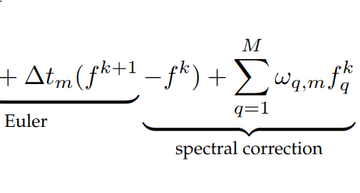
This thesis investigates spectral deferred correction (SDC) methods for the time integration of spatially discretized incompressible flow problems. SDC methods achieve high-order accuracy in time by iteratively correcting a low-order initial approximation, making them well-suited for coupling with spatial discretizations of different stiffness levels. The thesis applies SDC methods to incompressible flows discretized with H(div)-conforming HDG methods, analyzes convergence properties, and demonstrates performance on benchmark flow problems.

2022

Robust Finite Element Discretizations for a PDE arising in Helioseismology

Tilman Alemán

NAM, University of Göttingen · 2022

webdoicode

This thesis investigates robust finite element discretizations for a second-order indefinite vector PDE arising in helioseismology as a simplified version of Galbrun's equation. The key challenge is developing methods that are uniformly stable in physical parameters, in analogy to locking-free methods for nearly-incompressible elasticity. Identifying a connection to the Stokes problem via Helmholtz decomposition, the thesis proposes DG and HDG discretizations that exploit this structure to achieve robustness. Stability proofs and numerical experiments are provided.

Monolithic Unfitted Space-Time FEM for an Osmotic Cell Swelling Problem

Anna Clara Wendler

NAM, University of Göttingen · 2022

webdoicode

This thesis develops a monolithic unfitted space-time finite element method for an osmotic cell swelling problem, in which a cell membrane undergoes shape changes driven by osmotic pressure differences. The method couples the fluid flow equations in the interior and exterior regions with membrane mechanics in a common unfitted space-time framework without mesh adaptation. The monolithic coupling avoids operator-splitting errors. The thesis presents the method, discusses the solution of the resulting nonlinear system, and validates it on model problems.

Model Order Reduction for incompressible flows based on structure preserving discretizations

Parajal Rai

NAM, University of Göttingen · 2022

webdoicode

This thesis develops model order reduction (MOR) techniques for incompressible flow problems based on structure-preserving spatial discretizations. The goal is to construct reduced basis methods that inherit the conservation properties of the full-order model. The thesis applies the reduced basis method to flows discretized with H(div)-conforming HDG methods and demonstrates that structure preservation at the reduced level leads to improved stability and accuracy of the reduced order model.

Pure Eulerian unfitted FEM for Biological Fluid-Structure Interaction Problems

Michelle Kemper

NAM, University of Göttingen · 2022

webdoi

This thesis develops a purely Eulerian unfitted finite element method for biological fluid-structure interaction (FSI) problems in which a deformable elastic structure is immersed in a viscous fluid. In contrast to ALE-based approaches, the Eulerian framework avoids mesh deformation and allows the structure to undergo large deformations. The method is based on unfitted FEM (CutFEM) for the fluid in combination with a representation of the structure on a fixed background mesh. Numerical experiments on model biological FSI problems demonstrate the feasibility of the approach.

2021
AS

An HDG method for the Spalart-Allmaras model

Anton Schmid

NAM, University of Göttingen · 2021

This thesis develops a Hybrid Discontinuous Galerkin (HDG) discretization for the Spalart-Allmaras one-equation turbulence model, widely used in aeronautical applications. The HDG framework provides a natural setting for high-order discretization while maintaining computational efficiency through static condensation. The thesis formulates the discrete problem, addresses the nonlinear stabilization required for convection-dominated regimes, and tests the method on standard aerodynamic benchmark problems.

AI

Boundary layer enriched Hybrid Discontinuous Galerkin Methods for Convection dominated flow

Abdul Qadir Ibrahim

NAM, University of Göttingen · 2021

This thesis investigates boundary layer enriched Hybrid Discontinuous Galerkin (HDG) methods for convection-dominated flow problems. Standard finite element methods produce oscillatory solutions near boundary layers unless stabilization is added or the mesh is refined. The boundary layer enrichment approach adds problem-specific basis functions capturing the exponential boundary layer profile, reducing the need for mesh refinement. The thesis develops this enrichment in the HDG setting and demonstrates improved accuracy for convection-dominated benchmarks.

2020

On Discontinuous- and Continuous-In-Time Unfitted Space-Time Methods for PDEs on Moving Domains

Fabian Heimann

NAM, University of Göttingen · 2020

webdoi

This thesis investigates unfitted space-time finite element methods for PDEs on moving domains, comparing discontinuous-in-time (DG-in-time) and continuous-in-time formulations. The unfitted space-time approach uses a fixed background mesh and level set function to track the moving domain, avoiding remeshing. Both time discretization variants are developed, analyzed theoretically, and compared in numerical experiments with respect to accuracy, robustness, and computational cost.

2019

Higher order stabilized time stepping in unfitted finite element method on moving domains

Xingren Jin

NAM, University of Göttingen · 2019

web

This thesis investigates higher-order stabilized time-stepping schemes for unfitted finite element methods on moving domains. A key challenge is that degrees of freedom may become active or inactive as the domain moves, complicating multi-step time integration. The thesis develops stabilization strategies that allow BDF-type schemes to be applied robustly in this setting and demonstrates higher-order convergence in numerical experiments.

2018

Higher order unfitted isoparametric space-time FEM on moving domains

Janosch Preuß

NAM, University of Göttingen · 2018

webdoi

This thesis develops higher-order unfitted isoparametric space-time finite element methods for PDEs on moving domains. Building on the isoparametric unfitted FEM for static problems, a parametric mapping of the space-time mesh is used to achieve high-order accurate description of the moving interface. The thesis presents the method, analyzes its theoretical properties, and validates it in numerical experiments demonstrating the expected higher-order convergence rates in both space and time.

Shape Optimization for Interface Problems using unfitted Finite Elements

Hans-Georg Raumer

NAM, University of Göttingen · 2018

web

This thesis investigates shape optimization for interface problems using unfitted finite elements. The goal is to optimize the shape of an interface or embedded domain by minimizing a cost functional depending on the solution of a PDE posed on domains separated by the interface. The unfitted FEM framework avoids remeshing as the interface shape is varied, and the shape gradient is computed by differentiating the discrete energy. The thesis develops this approach and demonstrates it on interface optimization problems.

2010

Hybrid Discontinuous Galerkin Methods for Incompressible Flow Problems

Christoph Lehrenfeld

RWTH Aachen · 2010

webdoi

This thesis investigates hybrid discontinuous Galerkin (HDG) methods for the numerical solution of incompressible flow problems, specifically the Stokes and Navier-Stokes equations. HDG methods offer a favorable balance between the flexibility of DG methods and reduced computational cost achieved through static condensation. The thesis analyzes well-posedness and convergence of the HDG formulation, discusses efficient assembly and solution of the resulting linear systems, and presents numerical experiments demonstrating the performance of the method.

Bachelor's theses

2025

Distributed memory parallel computing for Discontinuous Galerkin methods in the Finite Element Software NGSolve

Maximilian Zienecker

NAM, University of Göttingen · 2025

pdfdoi

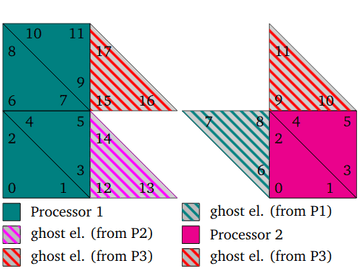
This thesis investigates distributed-memory parallel computing for Discontinuous Galerkin (DG) finite element methods within the NGSolve software framework. Efficient parallel computation requires careful distribution of the mesh and degrees of freedom across processes, parallel assembly of the system matrix, and parallel solution of the linear system. The thesis implements and evaluates a distributed-memory parallelization strategy for DG methods in NGSolve and demonstrates scalability on cluster benchmarks.

2022

The Virtual Element Method for Poisson’s equation in two-space dimensions

Anna Kahle

NAM, University of Göttingen · 2022

pdfdoi

This thesis implements and analyzes the Virtual Element Method (VEM) for Poisson's equation in two space dimensions. The VEM is a generalization of the finite element method to polygonal meshes of arbitrary shape, using virtual basis functions whose polynomial moments are computable without explicit representation. The thesis presents the VEM formulation, discusses the implementation, and verifies optimal convergence rates on structured and unstructured polygonal meshes.

2021

On a Discontinuous Galerkin discretization for a degenerate diffusion equation

Tim van Beeck

NAM, University of Göttingen · 2021

pdfdoi

This thesis studies Discontinuous Galerkin (DG) discretizations for a degenerate diffusion equation, a nonlinear PDE in which the diffusion coefficient vanishes in certain regions. Degenerate diffusion problems arise in models for porous medium flow and biological systems. The thesis formulates an appropriate DG discretization, analyzes its stability properties, and investigates the convergence behavior in numerical experiments.

2018

Higher order Discontinuous Galerkin methods for the Laplace-Beltrami problem on unfitted smooth surfaces

Fabian Heimann

NAM, University of Göttingen · 2018

pdfdoi

This thesis develops higher-order Discontinuous Galerkin (DG) methods for the Laplace-Beltrami problem on smooth surfaces described implicitly by level set functions. The trace FEM approach restricts the DG discretization from the ambient volume mesh to the implicitly defined surface. The thesis presents the method for arbitrary polynomial orders, discusses the stabilization needed for good conditioning, and confirms optimal convergence rates in numerical experiments.

2017

Model order reduction for linear PDE problems with the reduced basis method

Vivian Raulin

NAM, University of Göttingen · 2017

web

This thesis applies the reduced basis method for model order reduction of linear PDE problems with parametric dependence. The reduced basis method constructs a low-dimensional approximation space from carefully selected high-fidelity snapshots and enables rapid evaluation of the PDE solution for new parameter values. The thesis presents the method, discusses greedy snapshot selection and error certification, and demonstrates the approach on a parametric diffusion problem.